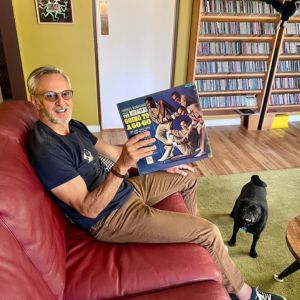
Len Romano is someone I deeply respect for his immense passion for music, especially soul. We connected on Instagram when he was rediscovering his vinyl collection. Right away, I felt a connection with him; he’s a rare gem. Len’s extensive knowledge of music is impressive, and he loves to share it. Following his Instagram page has introduced me to a lot of new music. I hope we meet in real life one day. Plus, his adorable dog, Lucy, is a real sweetheart.
From Sheffield to Albuquerque: Len’s Global Journey Through the World of Music
Born and raised in Sheffield, England, to a family of Italian immigrants, Len carries a deep appreciation for diverse cultures and musical influences. Growing up in a vibrant, multicultural neighborhood, he was immersed in a rich tapestry of sounds that shaped his lifelong passion for soul music. Len’s global perspective has been enriched by living and working in five countries and over a dozen cities, each contributing to his eclectic taste in music.
His love for music, arts, and culture brings a unique flavor to his storytelling, making him a perfect fit for sharing the magic of soul music. Len’s thoughtful communication and understanding of global contexts have helped him build lasting relationships, whether in business or through his musical journey.
Now residing in Albuquerque, USA, with his wife, Donna, and their two daughters, Len continues to nurture his love for soul music. Together, Len and Donna run a brand design firm called Ripe Inc., but his heart beats to the rhythm of the music that has always been a part of his life.

How did your love for music begin?
I grew up in Sheffield, England, in the 1970s. My family moved from Italy to Sheffield, joining neighbors from Jamaica, India, Pakistan, Poland, Ireland, and England, all seeking employment in a city that needed rebuilding after WWII. Our neighborhood was like a league of nations, nestled within a few inner-city blocks of terraced houses. We grew up sharing food, music, and cultures. The music I heard being played on the streets and at friends’ houses was mainly soul, reggae, and dub.
At that time, Sheffield was a hotbed for the underground soul scene known as “Northern Soul”—a British term for a specific kind of American soul music with a distinctive beat. It was a cult underground scene characterized by all-night dance sessions, unique, acrobatic dance steps, a specific fashion sense, and the use of stimulants like amphetamines to keep dancing throughout the night. The term ‘Northern Soul’ was coined by Dave Godin, a record shop owner in London, who noticed that visitors from the northern industrial cities of England, in London for football matches, preferred the uptempo, obscure soul records over the funk records popular with southerners. The northern kids were buying records that flopped in the USA and were typically modeled on the four-on-the-floor Motown sound, but that’s a major oversimplification. These records were ‘discovered’ by people traveling from England to the USA, digging in record shops and warehouses for unknown uptempo soul records released on hundreds of labels across the USA, each one trying to emulate the sound and success of Motown.
My introduction to soul music came from two places. The first was seeing the older lads and lasses in the neighborhood dancing to these incredible records they owned, practicing their athletic dance moves: spins, backdrops, splits, kicks, and slidy footwork. This blew my mind and made me want to know this music and learn these dance moves. The second place was the radio. Looking at the pop charts in the 1970s, soul music was big! Artists like Curtis Mayfield, Al Green, Marvin Gaye, Smokey Robinson, Roberta Flack, Gladys Knight, Aretha Franklin, Billy Paul, the O’Jays, and dozens more latched onto the mainstream consciousness with worldwide hits. So, I was exposed to the big soul hits of the day and, at the same time, tons of obscure 60s soul records by unknowns.
When did you start collecting vinyl records, and what was the first record in your collection?
I think I started around age 10. It was a poor neighborhood, so people didn’t have much money to buy records; we would swap things or acquire them by other means. All the houses had one record player, usually a beat-up old radiogram in the front room that everybody used and abused. Every house in my neighborhood seemed to have constant music playing, either from the radio or parents’ and older siblings’ records. And there always seemed to be people dancing or singing along. When a friend got a new record, the first thing everyone wanted to do was learn the words and practice singing it. This meant playing the record over and over until it was embedded.
A breakthrough for me was when I got my hands on a portable cassette recorder. Even though it was already old, I cherished it and looked after it as best I could. I remember the brand: it was a Prinzsound TR-3! As long as I had some space on a cassette tape, I could record from the radio, or I could record a snippet of a tune someone was playing in a house I was passing. I picked up sounds from everywhere, and that’s how I started collecting music. Once I knew the name of the song I’d recorded, I could be on the lookout for it.
Some of the earliest 45s I got my hands on were Edwin Starr – “Stop Her On Sight,” Desmond Dekker – “Israelites” and “007,” Smokey Robinson & The Miracles – “I Don’t Blame You At All,” Rupie Edwards – “Ire Feelings,” The Triumphs – “Coming To Your Rescue,” Major Lance – “Follow The Leader,” Tamala Lewis – “You Won’t Say Nothing,” The Reflections – “Like Adam & Eve,” Dean Parrish – “I’m On My Way,” and Marvin Gaye – “Can I Get a Witness.” I think the first album I acquired was a used copy of Motown Chartbusters Vol. 3 with the shiny cover. A fantastic compilation of Motown bangers. It was all about compilation albums in my youth because they had variety and value for money. As I said, we wanted the songs we could dance to and sing along with friends. Music was a communal experience. It connected us.
How many albums do you currently have in your collection? And how many genres do you currently have?
I’m not sure how many records or CDs I own, but I do know I have just over 45,000 songs I’ve uploaded into my iTunes library from digital purchases, CDs, and vinyl. I only just started buying records again in the last couple of years. I left the UK and all my records in 1991. About 20 years ago, I was told all my records had been tossed in a dumpster when my parents had a new roof put on the house. I was so upset with my mum, I barely spoke to her for a couple of months. After my parents died, one of my brothers was getting the house ready for sale and found a bunch of my old records in the roof space. I had no idea what condition they were in, but I shipped them over to the USA, and I’ve been very fortunate. None were damaged except for a minor warp here and there.
When my records arrived, I discovered that about half had been thrown out and half were put up in the roof. I’ll never know why half were saved. That secret died with my mum. As far as genres go, I buy music from all genres—except heavy metal. Music from the 1930s up to the present day. But the music that has the biggest impact on me, that touches me the deepest, is soul music. It’s always been that way with me. For the 30-plus years I was without my records, I bought cassettes, CDs, and digital music and have a large collection of music in all formats. I buy more digital music than anything else because I want access to it in all parts of my day—when I’m exercising, cooking, driving, working, etc. When I have some free time at home, I sit down and play the old records, which I still love to do as much as possible.
Do you have a favorite album or artist within the soul genre? If so, which one and why?
I couldn’t possibly single out one artist above all others, but if I were forced to pick a single album, it would have to be “What’s Going On” by Marvin Gaye.
I distinctly remember coming home from the record shop in the early ’80s, playing it from start to finish while staring at the gatefold album cover, reading all the info and musicians’ names, and thinking I loved about half of it, while the other half was beyond my tastes at the time. Not for long, though. I slowly grew into each song I previously didn’t care for.
The multi-tracked vocals, the loose, jazzy, groove-saturated music played by an intricately linked, almost telepathically connected group of musicians—the Funk Brothers. Each one giving the other room to breathe. The lyrics touching on global warming, love, compassion, spirituality, man’s destructive nature, and trigger-happy policing—so far ahead of its time.
Marvin’s singing. Let me say again, Marvin’s singing! It’s the album I’ve played the most through every period of my life, and I view it as a close friend. It’s the album I’ve played to friends, co-workers, girlfriends, and finally, the girlfriend who became my wife now loves it too.
My kids have grown up with it and know every word. I play it when I’m sad and when I’m happy. I can play it while I’m sitting still with a glass of wine, or when I’m cooking in the kitchen or driving on a road trip.
It was the first record I put on after returning to my home in the UK after my first six months of shoestring backpacking, and I’ve never felt so glad to be home. I’ve bought it in so many formats, in so many different cities and countries, almost like I’m scared to be without it.
I don’t doubt it will be the last music I ever hear before I leave this plane. I have a feeling my friends and family will see to that if they have the chance. Incredible record!

Are there specific periods in soul music that particularly appeal to you? Why?
I love it all. Soul music’s mama had one breast full of gospel milk and the other breast full of rhythm & blues milk, and baby Soul suckled both in abundance until the chubby infant finally showed up in Ray Charles’s “I Got a Woman” in 1954. It’s debatable, but I believe that was the first time the holy gospel fire showed up on a secular record, and it caught on quickly with artists like Hank Ballard, James Brown, Clyde McPhatter, and Etta James. I love soul music from its first days right up to the present day, but if I had to pick a peak period, for me, it would be 1967-1977.
During that time, soul music went from distinctly regional sounds and styles and escalated into a powerful and empowering art form that resonated across the world. By the mid-’70s, soul had gone through a psychedelic phase, embraced orchestras with symphonic sophistication, and splintered into funk, jazz-funk, disco, and myriad tones and colors.
Which records in your collection do you consider the rarest or most valuable?
I have no idea. I don’t focus much on rarity or value because, for every rare, expensive album, there are ten inexpensive ones that are still waiting to be discovered and recognized for their amazing artistry and craft. The only time I get to see what prices records are fetching nowadays is when I’m actively looking for a certain record and it’s not showing up anywhere when I’m out in the wild, sorting through dusty shelves. After a while, I’ll reluctantly look it up on Discogs or eBay and usually come away a little shocked and appalled, and then I’ll try to buy it digitally.
Nowadays, we have so many options to acquire music and actually pay for it where the artists involved (including the musicians, arrangers, writers, producers, or their families at least) might still benefit from our purchases. Whether that’s a digital album, a CD, or a licensed reissue of the vinyl. Whereas if I spend $500 on a used record from a private seller, just to own it, the artists don’t see a penny of that and the only person benefitting financially is the seller. I totally understand the collector’s mindset, and I’m not trying to diminish their hobby in any way. I’m just stating what works best for me. I’m aware this might not align with some readers who are true collectors, but I consider myself more of a music fanatic than a vinyl record fanatic.
Are there specific record labels that you collect? What makes these labels special to you?
I wouldn’t say I “collect” them, but I’m always on the lookout for anything on Mirwood, Stax, Shrine, Goldwax, Revilot, Fame, Ric-Tic, Sidra, Quinvy, Mala, any Solid Hitbound, or Pied Piper productions. There are so many labels and logos out there that get my heart pumping, but those are a few that immediately come to mind. There are lots of labels, studios, and producers who created a unique sound that consistently delivered incredible artistry and unforgettable grooves. I love it when I hear a record that I don’t know but can name the artist, the label, or even the producer.
What are some of the most memorable stories or anecdotes behind certain albums in your collection?
So many records, so many memories. Where to begin? I’m lucky to have seen a lot of my musical heroes and heroines live on stage. The first gig I ever attended was when I was 16 years old. It was Sylvester, and he blew the roof off the place. I couldn’t believe the fire he brought that night.
Another unforgettable experience was the night my friends and I went to see Edwin Starr in 1984. He blew my mind. I could not believe how great and soulful he was. I was beside myself, and the whole room was packed tight like sardines, with condensation running down the walls, and Edwin on stage giving it everything he had. He left every ounce of himself out there on the stage floor. It’s a night I’ll never forget. My friends and I were squeezing each other in bear hugs because we couldn’t believe what we were hearing. Agent Double-O-Soul was 10 feet away from us, screaming soul music directly into our hearts. It was magical.
Another memory is the night I sang lead with the Temptations on my 23rd birthday in front of thousands at a concert in my hometown of Sheffield in 1988. I attended the concert with about 30 friends, and the crowd was all singing along to “My Girl.” In the middle of the song, Richard Street asked if anyone would like to get up on stage and sing with them. My friends immediately picked me up, carried me shoulder high, and practically threw me up there. I was so nervous, but it ended up being the most exciting five minutes of my life. This sounds like bullshit, but a few ladies came up to me after the show and gave me their numbers! Haha! It’s the truth; I tasted fame for five minutes.
When I moved to New York in 1991 for a job, I was doing a bit of work on the side for a UK soul music magazine called Voices From The Shadows (well worth picking up if you find any old copies), and they put me in touch with the underground soul duo, Thomas & Taylor (Lamar Thomas and Judy Taylor), who lived in Queens close by and we became friends. We used to hang out, sing together, and play music. Lamar’s cousin was Ivory Stone, who was a backup singer for Smokey Robinson. I had been a fan of Smokey Robinson since I was a little kid, so when Lamar and Judy asked if I wanted to join them to meet up with Ivory after one of Smokey’s gigs, I jumped at the chance. That night, I got to meet and hang out with Smokey, a living legend. He was so cool, no ego or star power. Just a good guy.
I do try to document my memories and stories on my Instagram page, which is @returntorecords. I don’t post very often, but I try to communicate something special about each record I post. So, please feel free to check me out there, but if you don’t like reading, you probably won’t like my posts.

How do you think soul music has evolved over the years?
Soul music is constantly evolving and rolling with the punches of changing musical landscapes and societal shifts. Things slowed down for soul when disco took over, but it had to adapt to survive.
Back in the early ’60s, Motown set the stage for soul music’s crossover appeal with its polished production and killer roster. I mean, look at who walked through their doors and stood in front of a mic: Stevie Wonder, Marvin Gaye, Smokey Robinson, Gladys Knight & the Pips, Edwin Starr, Four Tops, Junior Walker, The Temptations, The Supremes… and so many more. These were just talented kids from the projects, but Motown polished them up and transformed them into superstars. Berry Gordy’s Motown family brought soul music into the mainstream. Meanwhile, 300 miles away in Chicago, Carl Davis, Johnny Pate, and Curtis Mayfield were busy crafting a sound signature unique to the Windy City. And down in Memphis, Estelle, Jim, Booker T., and the gang at Stax were doing their own thing too, but with a distinctly fatback southern groove smothered in grits and molasses.
As soul quickly caught on, it evolved into a powerful voice for the Civil Rights Movement. Songs like Sam Cooke’s “A Change Is Gonna Come,” The Impressions’ “We’re a Winner” and “Keep On Pushing,” and Aretha Franklin’s “Respect” became anthems for everyday people, reflecting the social and political struggles of the time.
By the 1970s, soul music was mixing it up with funk and disco. This evolution was crucial for keeping soul alive and kicking. It embraced new rhythms and sounds, with artists like James Brown, Funkadelic, Sly & The Family Stone, and Earth, Wind & Fire blending soul with funk’s grooves and disco’s flamboyance.
In the ’80s, soul had to adapt again as hip-hop and electronic music took the spotlight. Artists like Luther Vandross and Anita Baker kept things cooking without sweating by implementing a more polished, adult contemporary sound, often called “quiet storm” (Thank you, Smokey!). Synthesizers and drum machines were everywhere, and many purists didn’t like it.
This backlash created the neo-soul movement, reconnecting modern audiences with soul’s roots while mixing in contemporary elements. Artists like D’Angelo, Erykah Badu, and Lauryn Hill brought soul back to life by blending it with R&B, jazz, and hip-hop vibes.
In the last 20 years, there’s been a cool throwback scene with retro soul acts popping up everywhere. Artists like Amy Winehouse, Leon Bridges, Sharon Jones & The Dap-Kings, and Durand Jones embraced vintage aesthetics, bringing the classic soul sound to new generations.
Soul music’s evolution reflects the broader cultural, social, and technological changes over the decades. From its gospel roots to mixing things up with other genres, soul has always adapted while keeping its emotional and expressive core. This constant ability to shapeshift keeps it relevant and impactful in the music world.
As you know, this is a very brief overview. There’s so much more to this story.
Are there modern artists or bands that you think carry on the legacy of soul music well?
I am constantly hearing new music that trips my soul sensors and stops me in my tracks. One of the biggest changes from soul music’s early days is that it all started when gospel singers left the church and swapped “Jesus” for “baby.” Those gospel-fired voices had the hardest time adapting during the disco and post-disco years. Singers then emerged who weren’t raised in the church; instead, they were raised on Stevie Wonder, Dionne Warwick, Diana Ross, and Donny Hathaway. Eventually, those testifying, down-on-your-knees singers who reach for the most out-of-reach notes and will sacrifice their own sanity to always take it higher found their way back home to the church. But make no mistake, they are still with us.
There’s a singer called Le’Andria Johnson who is as talented and ferocious as they come, but she hasn’t been tempted away from the church yet to make a secular soul/R&B record. But if she ever does… watch out. That lady is the real deal. Another great gospel act is the Sensational Barnes Brothers, who put out a deeply soulful album in 2019 called “Nobody’s Fault But My Own.” Again, it’s gospel but will appeal to any soul fan. Highly recommended.
As far as modern versions of soul music, I hear soulful sounds from all over the place. Nai Palm from Australia is something special. So are Joy Crookes and Michael Kiwanuka from London. Or Snoh Aalegra from Sweden. As for American acts, I really dig Durand Jones & The Indications, Curtis Harding, Thee Sacred Souls, Moses Sumney, Jalen Ngonda, Black Pumas, Gregory Porter and so many more. Soul music is in a healthy place today. Yes, indeed.
What influence do you think soul music has had on other music genres?
I hear elements of soul music in all genres now—except perhaps heavy metal, which is probably why it stays off my radar. Soul music’s influence can be heard in country, funk, blues, reggae, jazz, house, drum & bass, trip hop, hip hop, pop, and… the beat goes on. Music is blurring lines and fusing together like never before. Barriers are being torn down in a very positive way. Music is the true universal language. Music is medicine.
Are there concerts or live performances that left a lasting impression on you? Which ones?
I was lucky enough to catch Sam Dees live on stage at Dingwalls in London during the late ’80s. It was a small, standing-room-only club, and the place was packed tight with soul fans eager to catch their first glimpse of a man who’d been held in such high regard for so long but nobody had ever seen, apart from a few blurry photos. He walked on stage, and the crowd erupted. It was pure amazement and elation before he’d even sung a note. After his first song, the crowd kept the applause and loud cheers going for an extended length of time. Sam was overwhelmed. Here was a man who had written so many phenomenal songs for so many artists and had recorded one of the greatest soul albums of all time, “The Show Must Go On,” but he didn’t have the recognition to sell half a dozen tickets across the Atlantic in the USA. To his great surprise, he’s touring the UK and performing to packed houses every night. He told the crowd, “Y’all better stop or you gonna see a big man cry up here.” He did shed a few tears before carrying on with the show. It was an amazing night, and Sam Dees is an amazing artist.
Earlier, I mentioned the magazine I was doing a bit of work for, Voices From The Shadows. Well, one of the other contributors was the legendary Swamp Dogg (Jerry Williams Jr.), and I had been in awe of him since I was a teenager. Because we had the magazine as a connection, there was a period in the mid-’90s when we used to call each other up and talk on the phone occasionally. One day, while chatting, I could hear he was sitting at his piano (he affectionately called me the “soul plumber” because I was a plumber at the time who also did a bit of soul music-related work). I asked him to sing one of his songs for me. He obliged, and I chose “Did I Come Back Too Soon, Or Did I Stay Away Too Long,” which Freddie North recorded. It was about a guy who was faithful and loving, and one day returned home to find his wife making love to someone else. He was stunned, to say the least, and even more so when he found out the other person was a woman. After a few fumbled notes and false starts, he launched into the song, and I was blown away by his performance. I frantically motioned for my girlfriend (now wife) to come over, and we both listened with our jaws on the floor. About 10 years later, long after the magazine had folded, I had the pleasure of meeting him in person during a music festival in DC. I watched his show and then went behind the tent where the acts were performing and asked the security guard to let Swamp Dogg know that the “soul plumber” was here. A couple of minutes later, out walks Swamp Dogg and gives me a hug. He was so warm and generous with his time and even remembered all sorts of details we had discussed in our phone conversations from years before. He’s a legend and a really cool guy.
Are there any projects or collaborations you’re currently working on or would like to work on in the future related to your passion for soul music?
When I was younger, I always had something cooking. I once pitched an idea to feature Swamp Dogg, Jimmy Lewis, and Sam Dees on VH1 for their Storytellers series. Although I got permission from all three artists, they warned me that I would never get it passed. Undeterred, I pushed on and even managed to get through to the VH1 programming decision-maker, who loved the idea but ultimately couldn’t convince the advertisers to back it. So, after months of effort, nothing came of it, but I got the chance to discuss the idea with three soul music heroes who knew all along from experience that it would never happen but appreciated my enthusiasm and optimism. I think they all thought I was a little crazy.
I’m not working on anything specific at the moment because I run a small business and have two daughters, one of whom is studying fashion design at the Academy of Art University in San Francisco. So I need to hustle with my business to keep those bills paid.
Having said that, I get invited to take over a 3-hour radio show about twice a year. It’s a blues show, but the DJ is a friend of mine, and he likes to switch things up for his audience by doing a couple of soul shows a year. I get to pick the theme and make the entire 3-hour playlist with music from my own collection. It’s a lot of fun.
I’m a simple music fan with a passion for learning as much as I can. My appetite is as strong as ever, and my life has been enhanced in every way imaginable by pursuing this passion for music. Thanks for inviting me to answer these questions. I feel honored to share my love for soul music with you and your readers.
In Tune with the Past: Lud, Pepsi Maycock, and the Melodies That Bind Us

My oldest brother, Lud, broke free from our neighborhood confines as a young boy by joining the local dance studio. He worked his arse off and became good enough to turn pro and move to London. I loved it when he came home for the weekends; the entire neighborhood was proud of him, and everyone treated him like a celebrity. I loved it even more when he brought his dancer girlfriends to visit—tall, free-spirited, beautiful women, full of zest and theatrical ways. My heart melted every time I was around them.
One of these ladies, London-born and Afro-Caribbean, Pepsi Maycock, took a shine to me. She was so full of life, laughter, and love. After learning about my interest in soul music, she gave me this album as a gift when I visited Lud in London for a weekend. See pic in Lud’s London flat – 1977. She bought it as a young teen on release, and on the back cover, it still has a pen-scribbled message of unrequited love, “Pepsi Maycock loves K. Phillip and he doesn’t love me.” I played this record from start to finish month after month and year after year. It has always been one of my most cherished possessions. I often wonder about Pepsi and hope she’s thriving. My brother is no longer with us, but every time I play this album (and one song in particular), it vividly brings back memories of them both dancing, laughing, and hugging each other. Sing it, Smokey!